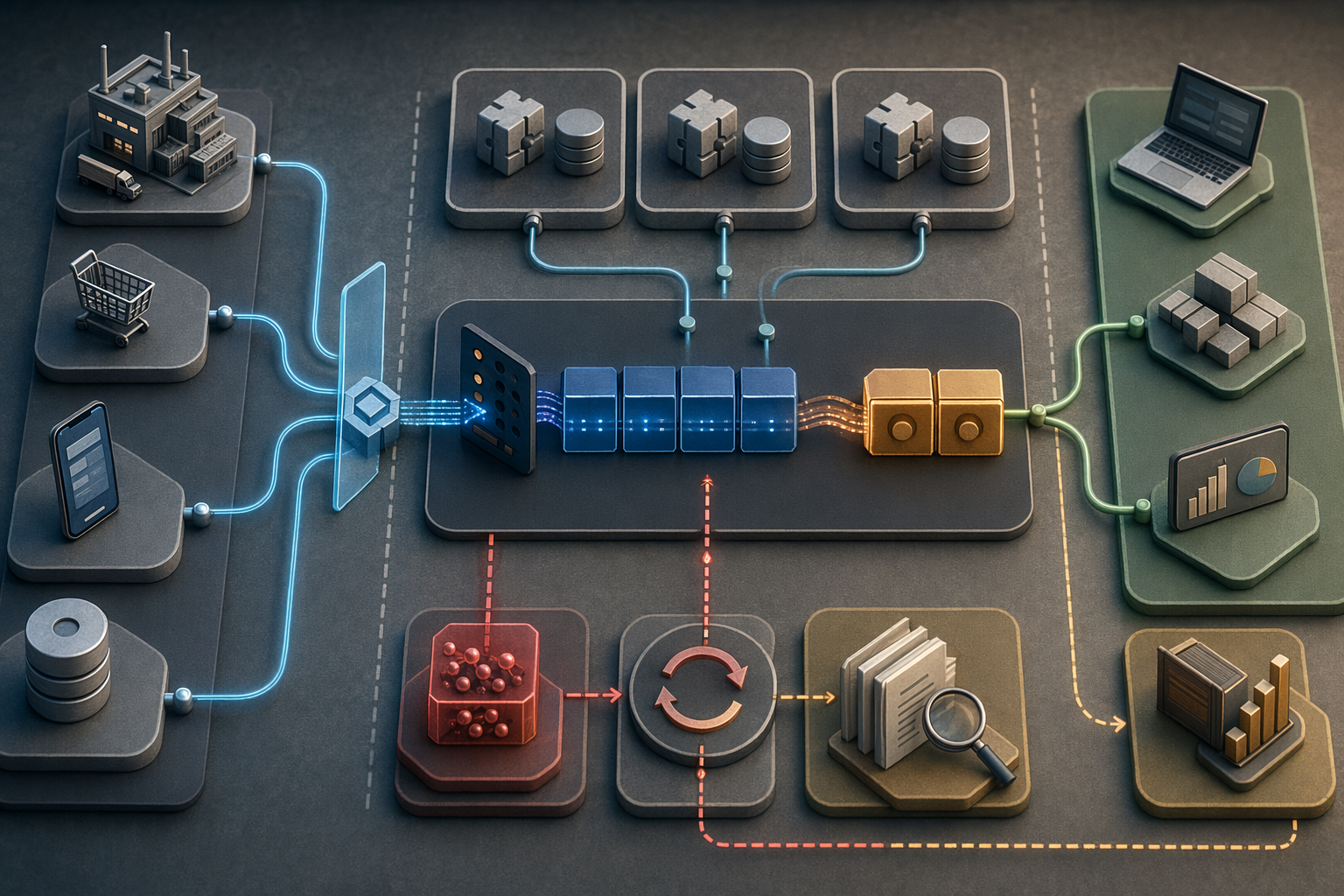
Teams often describe event-driven architecture as a way to reduce coupling, improve scale, and move delivery faster. Those benefits are real, but they only show up when the operating model is designed as carefully as the event flow itself. In practice, many programs get the opposite result: more hidden failure states, slower diagnosis, and a long queue of “temporary” manual fixes that become permanent.
The failure is usually not the broker, the queue, or the event schema. It is the missing design around exception operations. When a workflow spans events, background processors, APIs, and human teams, the happy path is only a small part of the architecture. What matters just as much is who notices a broken handoff, who decides whether to replay, what state is authoritative, and how downstream teams confirm that recovery actually worked.
Why the happy path is the easy part
Most architecture reviews see detailed diagrams for the normal flow: event produced, event consumed, state updated, notification sent. Those diagrams look clean because they assume timely delivery, valid payloads, idempotent handlers, and stable downstream dependencies. Production reality is messier. Events arrive late. Consumers change behavior. Duplicate processing slips through. A downstream API accepts the request but fails before persistence. A support team sees a customer-impacting issue but has no clear way to trace the broken sequence.
That is why event-driven architecture should never be reviewed as a messaging pattern alone. It is an operating system for business change. Once the process is distributed, the architecture has to answer operational questions that were previously hidden inside one application or one database transaction.
Design exception operations as a first-class system
A practical review should force explicit decisions in four areas.
1. System-of-record boundaries
Every important event should point back to a clear authority. If an onboarding workflow emits five events across three platforms, which system decides whether onboarding is complete? Which system is trusted when two records disagree? Without that answer, replay can make the situation worse by spreading the wrong state faster.
2. Replay and reconciliation rules
Replay is not a universal recovery button. Some events are safe to replay automatically. Others require sequence checks, deduplication, or business approval. Reconciliation also needs an owner. If one platform thinks a payment instruction succeeded and another does not, the architecture has to define where that mismatch is detected, how it is surfaced, and who resolves it.
3. Support-facing observability
Technical telemetry is necessary but not sufficient. Support and operations teams need views that map system failures back to customer or business impact. A graph full of consumer lag and retry counts may help engineering, but it does not tell an operations lead which onboarding cases are stalled, which payment files need intervention, or which business commitments are at risk.
4. Ownership at each handoff
Distributed systems create ambiguity unless ownership is assigned at every boundary. An event contract needs a producer owner, a consumer owner, and a defined escalation path when assumptions break. If recovery depends on three teams informally coordinating in chat, the design is not finished.
What strong event-driven reviews surface early
Good architecture reviews make hidden operating assumptions visible before scale amplifies them. The discussion should get specific enough to answer questions like these:
- Which failures can self-heal, and which require human review?
- What evidence proves that a replay corrected business state rather than duplicated it?
- Where does an operations team see the exact set of affected customers, orders, payments, or cases?
- Which exceptions are acceptable backlog, and which become immediate operational incidents?
- What is the fallback path if a downstream consumer remains unavailable for hours instead of minutes?
Those questions are harder than comparing brokers or debating choreography versus orchestration. They are also the questions that determine whether an event-driven design becomes a stable operating model or a distributed support burden.
Where teams usually underinvest
Many programs treat exception handling as an implementation detail to be cleaned up after initial delivery. That is a mistake for any architecture that crosses product, platform, and operations boundaries. Recovery tooling, traceability, dead-letter handling, and business reconciliation should be funded as part of the core design. If they are postponed, the organization still pays for them later, just through incident load, manual correction, and delivery drag.
This matters even more in modernization programs. Teams moving from centralized integration platforms to API and event patterns often remove visible orchestration without replacing the operational discipline that orchestration used to impose. The result looks more modern on paper but behaves less predictably under pressure.
Next step
If an event-driven initiative is already underway, review the exception path architecture before more producers and consumers are added. Force the ownership, replay, reconciliation, and support-model decisions while the system is still understandable. That review usually prevents more risk than another round of platform comparison.
Integration modernization review is a practical next step when a team needs to pressure-test event boundaries, recovery design, and operating ownership in a real delivery context.
Join the discussion
You must be logged in to post a comment.