At 10:02, the new posting service commits a transfer between two internal clearing accounts. The caller times out before it receives the posting reference. At 10:03, the cutover lead sees error rates spike and asks to switch back to the legacy service.
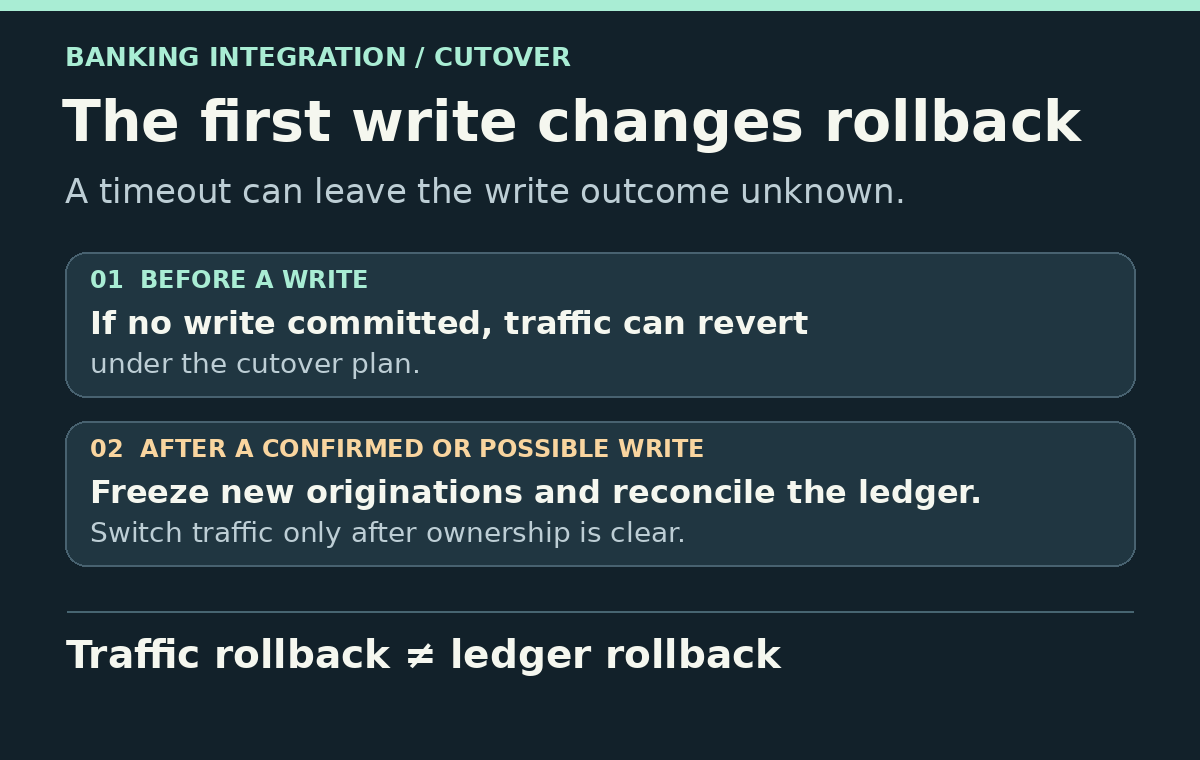
Turning traffic back is quick. Deciding what the legacy writer is allowed to do is harder. If it has not seen the new commit, it may receive the same request and post it again. The important cutover milestone is not when the router changes. It is when the new system can first commit a production write that the legacy system cannot yet prove it knows about.
Follow one posting through the switch
In this hypothetical cutover, the legacy writer has been drained and blocked from writing. Its last verified journal boundary is checkpoint L. Both sides agree that the new writer starts from that baseline. The new service takes the first live instruction, business ID MOVE-1042, for a CAD 500 internal transfer. It commits balanced debit and credit entries and records the outcome for MOVE-1042 in the same local transaction. The client never gets the response.
The timeout tells the caller nothing about whether a commit happened. A read from the old ledger only proves what the old ledger can see. If the new ledger is reachable, an authoritative lookup by business ID can find the committed outcome and return its posting reference without executing the instruction again. If the new ledger is temporarily unavailable, hold that instruction as unresolved. Do not let a retry, a queue redelivery or a manual tool send it to the former writer.
Give operators a decision they can run
| Evidence at the decision point | Action |
|---|---|
| New writer has no committed production writes. Both sides are quiesced; no in-flight operation can commit later; the old ledger is still current. | Keep the new writer blocked. Restore the legacy writer and traffic under the original authority only after verifying those conditions. |
| A new commit is known; the new ledger remains reachable. | Keep the new ledger authoritative. Restore the previous application build only if it is compatible with that ledger and its request history. Otherwise pause new writes and repair forward. |
| The new ledger is unavailable, or a commit is still possible but its outcome is unknown. | Pause affected writes. Preserve pending instructions and their IDs; reconcile from an authoritative recovery source before replaying them. Do not restore the old writer against an unverified copy. |
| A failback after new writes is required. | Block both writers, prove the destination has the full committed range and request outcomes, resolve or quarantine remaining ambiguities, then grant exclusive write authority to the legacy side. |
The first row requires positive evidence, not a dashboard showing zero successful responses. Quiesce new admission, drain or terminate outstanding writers, and verify the write block is effective before taking the final journal checkpoint. Have the cutover lead and ledger owner record which row applies and what evidence they used.
A high-water mark needs a definition
Define a high-water mark as a boundary in the authoritative commit history, not the largest ID anyone saw or the time a replication dashboard turned green. Suppose the new ledger has reconciled commits through N19; the failback destination has confirmed only through N18. You cannot grant it write authority yet, even if both ledgers show equal net totals. Find what happened to N19, including the corresponding business ID and saved outcome. Check completeness across the covered range with the journal or an equivalent verified replay manifest. If streams are partitioned, use a boundary for each partition rather than inventing a global order.
Validate more than the debit and credit rows. A destination missing the posting outcome may replay the same instruction after failback. And replication alone is not proof the destination can take writes: for example, PostgreSQL 19 documents limitations on schema and sequence replication. Check the actual version, replication configuration, and write-side dependencies in the rehearsal.
Put exclusivity at the write boundary
Both the caller and any retry worker should carry the original business ID. On one authoritative ledger, write the posting and its durable outcome together using an atomic transaction; enforce uniqueness on the non-null, appropriately scoped business ID. A repeated ID with the same intent can return the saved outcome. The same ID with a different amount or account pair should be rejected for investigation. PostgreSQL transactions and unique constraints are examples of local primitives, not guarantees across two independent ledgers.
Fence the writer where the transaction is authorized, not just at the load balancer. For example, when a database controls both posting and a writer generation, serialize the authority change with transactions that check the generation. For independent ledgers, a local generation copied to both sides does not prove exclusivity; use a control that prevents the retired writer from committing, including through stale instances or batch jobs. If the cutover team cannot prove the fence, the safe tradeoff is a bounded write outage while the ambiguity is investigated, not availability by admitting writes on both sides.
Finally, failback is not a ledger reversal. If an entry was genuinely wrong, use the ledger’s approved compensating-posting process, with a new ID, a reference to the original and a durable audit trail. A correct posting with a lost acknowledgment needs its outcome recovered, not its money moved again.
Rehearse by killing the connection after the first commit but before the caller receives its result. The passing outcome is simple: one committed posting, one authoritative writer, and an operator who can show which evidence allowed the next step.
Join the discussion
You must be logged in to post a comment.