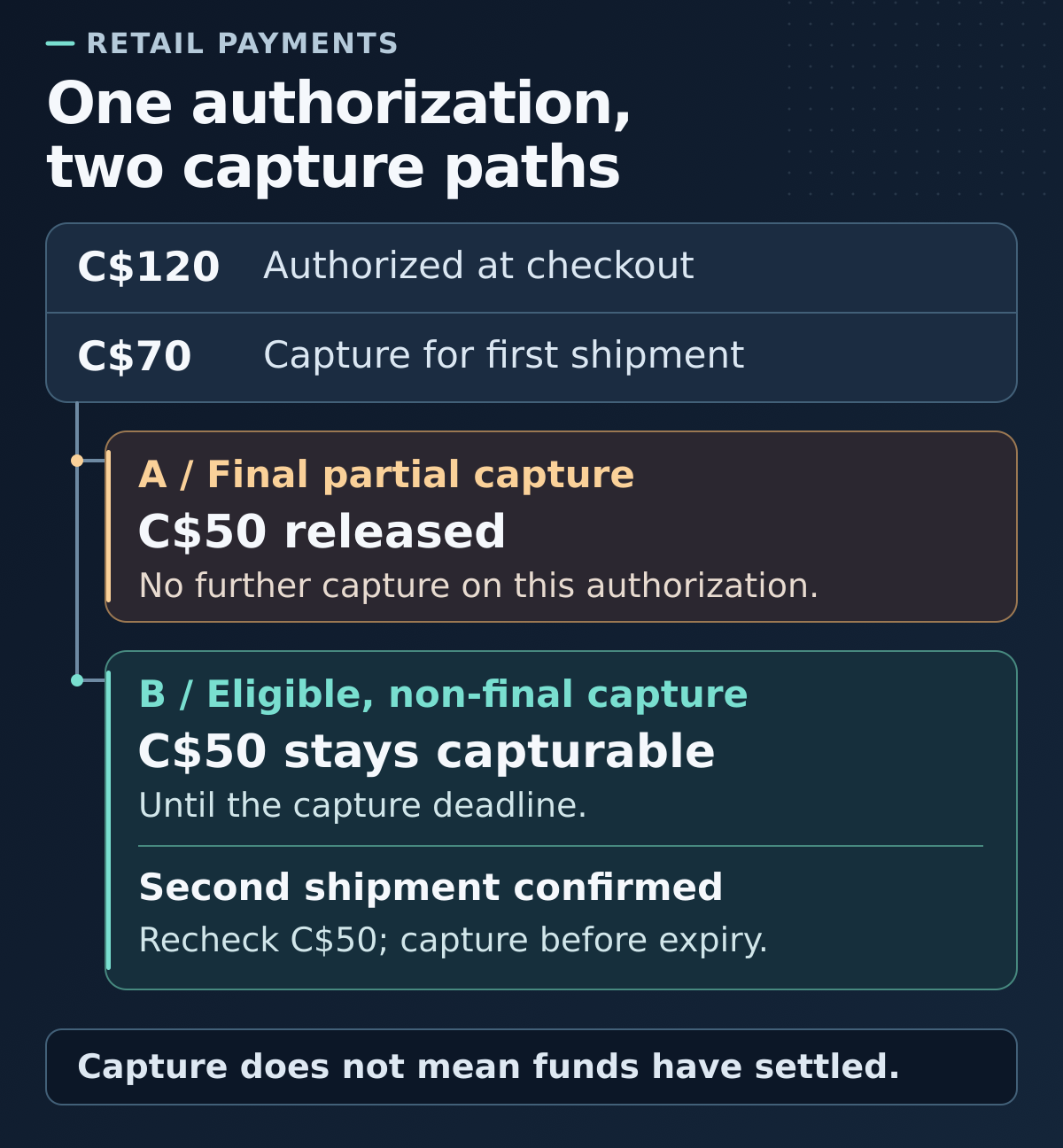
In a hypothetical online store, a customer places a C$120 order. The first package accounts for C$70 and ships today. The second accounts for C$50 and is due to ship two days later. The warehouse knows what went out. It does not know whether the payment authorization will survive the first capture.
That is the design question to answer before the first package ships. An ordinary partial capture can close the authorization and release the unused C$50. An eligible non-final capture can leave that C$50 available, but only until the authorization expires. The same first shipment can lead to two very different payment outcomes.
Choose the path before fulfillment
In a direct Stripe integration, set capture_method=manual and request multicapture. Then check whether the latest charge reports multicapture as available. Requesting it is not evidence that it is available for that payment. Stripe’s multicapture guide describes its online card, account and payment eligibility limits. For an eligible C$120 authorization, capture 7,000 CAD minor units with final_capture=false for the first shipment and verify that amount_capturable is still 5,000 and the currency is CAD. If the second shipment is confirmed within the window and the funds are still capturable, capture 5,000 with final_capture=true.
For a payment without multicapture, do not treat an ordinary C$70 partial capture as the first installment of that same authorization. Stripe’s manual capture guide explains that ordinary partial capture releases the balance. Decide whether to wait to capture the full order, ship only the items covered by the partial capture and arrange a new authorized payment for the rest, or use another supported business flow. These are choices for the merchant’s payment and fulfillment policy, not fallback actions a warehouse event should improvise.
Shopify’s setting is not a Stripe API switch
Shopify’s automatic capture per fulfillment is a Shopify Plus feature and depends on provider and payment-method support. Shopify documents that its automatic flow can capture the entire order at the first fulfillment when multiple partial captures are unsupported. That is not the behavior of a direct Stripe request to capture just C$70. Shopify also captures remaining amounts such as shipping at final fulfillment under this setting, so confirm how charges and discounts are allocated before promising an amount for each package. In a direct integration, define that allocation too, including taxes, discounts and shipping under the merchant’s policy. Do not run a second automatic capture app against the same orders.
Treat the deadline as data
Record the provider’s actual expiration timestamp, such as payment_method_details.card.capture_before on the Stripe card charge, and schedule an alert before it. A warehouse estimate is not a payment deadline, and a fixed seven-day timer is not reliable across card and transaction types. If the second shipment slips beyond that deadline, route it for a merchant-approved decision before release. The first C$70 capture remains a completed payment action; the expired authorization is no longer available for the remaining C$50. Do not interpret a successful payment status as proof that the whole C$120 was collected.
Make each shipment capture recoverable
Record one capture operation per fulfillment, with the payment reference, fulfillment ID, allocated amount, currency, final-capture flag and a stable idempotency key. In this example, allow only one capture operation in flight per authorization so an unexplained change in the provider total does not get assigned to the wrong shipment. If the C$70 request times out, leave it unresolved and check current provider amounts and activity before releasing the second request. Where a retry is appropriate, use the same key and parameters within the provider’s supported window. Stripe’s API v1 idempotency rules allow old keys to be pruned after at least 24 hours, so an old key is not a substitute for reconciliation.
Before rollout, test five outcomes: both captures succeed; the first capture is final; the remaining C$50 can no longer be captured because the authorization expired; the C$70 request succeeds but its response is lost; and Shopify captures the full C$120 at first fulfillment, leaving nothing to capture on the second. In each case the order view should say what shipped, what was captured and whether any amount is still capturable. If the provider shows no remaining capturable balance, stop retries and send the unpaid shipment to the approved payment-recovery queue. Keep payout and settlement reconciliation separate. The control that matters here is whether the next shipment still has an authorization it can use.
Join the discussion
You must be logged in to post a comment.