Architecture Advisory
Architecture decisions before they become delivery risk.
Architecture decision support for AI, integration, and cloud modernization programs where reliability, ownership, rollback, and delivery risk matter. Useful when teams need production-ready AI/RAG/agent boundaries, BizTalk or ESB modernization paths, integration contracts, observability, and executive decisions that can survive delivery reality.
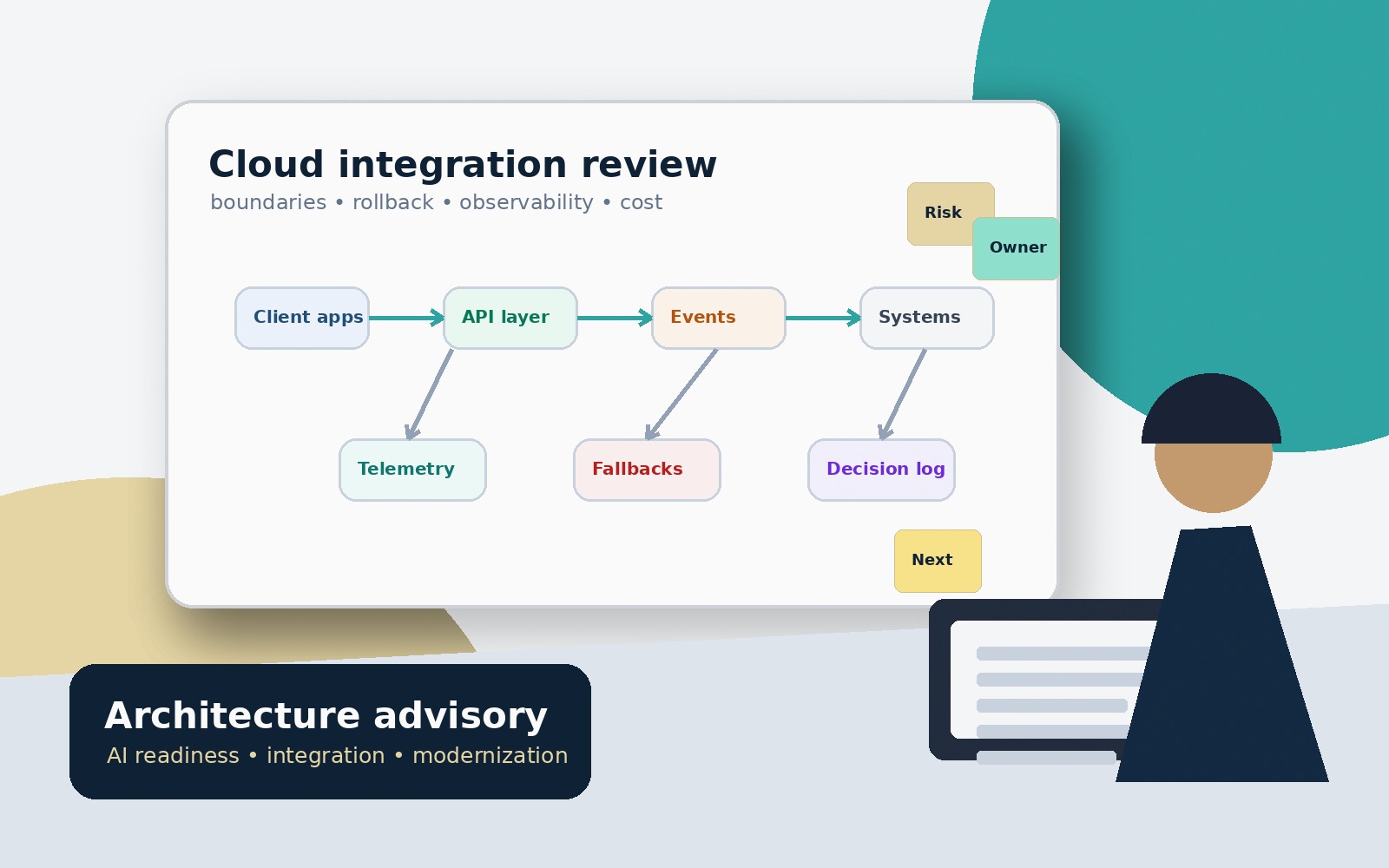
Problems I help with
Concrete architecture pressure, not generic consulting categories.
Legacy integration
We are modernizing legacy integration.
For teams moving from BizTalk/ESB-style integration toward Azure Logic Apps, APIs, events, or cloud-native workflows.
- System-of-record boundaries
- Sync vs async decisions
- Contract design
- Retries and idempotency
- Reconciliation
- Cutover and rollback
AI production
We want AI/RAG/agents in production.
For teams moving past prototypes and needing production boundaries before AI workflows touch real customers or operations.
- Retrieval freshness
- Source-of-truth ownership
- Evaluation and human review
- Latency/cost controls
- Fallback paths
- Auditability
Modernization risk
Our modernization plan is too risky.
For cloud modernization programs where sequencing, dependencies, rollback, and the operating model are unclear.
- Dependency mapping
- Migration sequencing
- Observability
- Failure modes
- Cost/performance tradeoffs
- Operational ownership
Executive decision
Executives need a decision, not more diagrams.
For leaders who need a clear architecture decision memo before funding, platform selection, migration, or vendor commitment.
- Decision memo
- Options comparison
- Risk register
- Recommended path
- Next actions and owners
Where this experience applies
Architecture review is strongest when it understands the domain pressure.
Architecture review is most useful when it understands the domain pressure, not just the diagram.
Core banking and digital banking
Modernization across banking flows and platforms.
Domain exposure across U.S. core banking transformation, Canadian digital banking onboarding, retail and business banking flows, credit-union integration across 20+ systems, commercial lending, and business banking payments.
Review core banking and digital banking architecture -> Read the core banking modernization architecture note ->
Payments and financial services integration
Payment streams need clean boundaries and exception paths.
Payments modernization work benefits from ISO 20022-aware modernization language, API/event boundaries, reconciliation, auditability, and operational exception handling.
Healthcare and insurance integration
Interoperability is an architecture concern, not only a data format.
Healthcare system integration, HL7/FHIR interoperability, clinical and workflow data exchange, life insurance integration, data quality, and reliability all need clear ownership.
Cloud platform and modernization
Cloud decisions need operating model clarity.
Experience across AWS, Azure, Google Cloud, Kubernetes and container platforms, serverless workflows, observability, cost/performance tradeoffs, rollback, and ownership.
AI production readiness
RAG and agentic workflows need production boundaries.
Production AI review focuses on retrieval freshness, source ownership, human-in-the-loop review, evals, fallback paths, telemetry, cost/latency controls, privacy boundaries, and auditability.
Integration modernization
BizTalk and ESB modernization needs more than a migration path.
Integration modernization review covers Azure Logic Apps, API Management, Service Bus, event-driven architecture, sync vs async tradeoffs, idempotency, reconciliation, and rollback.
What to send before a review
Useful context beats polished decks.
- Current architecture diagram or rough sketch
- Integration inventory
- Known failure modes or incidents
- Roadmap or migration plan
- Constraints: budget, timeline, vendor/platform commitments
- Decision that needs to be made
- People who need to agree
What the first conversation should clarify
Enough clarity to choose the right review shape.
- The decision being made
- Systems and teams affected
- Main risks
- Missing information
- Whether a short review is enough
- Likely artifact: decision memo, risk register, readiness brief, or boundary map
Patterns from prior work
Anonymized examples of the kind of architecture pressure this work is built for.
No client names, fake outcomes, or invented metrics. These are domain patterns and pressure points from prior work.
Core banking transformation
Worked across core banking modernization contexts where integration boundaries, cutover sequencing, reconciliation, and operational ownership had to be made explicit.
Digital banking onboarding
Experience across retail and business banking onboarding flows where many dependent systems needed consistent contracts, exception handling, and support paths.
Credit union integration
Experience with credit-union retail banking platform integration across 20+ systems, where system-of-record boundaries and cutover risk mattered.
Payments stream
Business banking payments stream experience involving downstream impacts, exception handling, reconciliation, auditability, and operating ownership.
Healthcare and insurance integration
Healthcare and life-insurance integration experience where interoperability, data quality, reliability, and workflow ownership mattered.
Applied AI product work
ExpenseJournal product work applies OCR/AI extraction, semantic search, human confirmation, telemetry, evidence reporting, and privacy/supportability thinking.
Productized advisory
Focused reviews with decision-ready outputs.
Offer 01
Architecture Decision Sprint
- Best for
- A team facing a platform, integration, cloud, core banking modernization, digital banking integration, commercial lending system integration, payments modernization, or AI architecture decision and needing a clear recommendation.
- Inputs
- Current diagrams, backlog/roadmap, integration inventory, constraints, operational concerns, and stakeholder concerns.
- Deliverables
- Decision memo, architecture options, risk register, recommended path, and owner/action list.
- Output artifact
- 8-12 page architecture decision memo.
Offer 02
AI Production Readiness Review
- Best for
- Teams moving from AI prototype to production workflow with RAG, search, LLM evaluation, evals, or agentic workflow boundaries.
- Scope
- RAG/source boundaries, model/tool usage, retrieval freshness, human-in-the-loop review, fallback paths, LLM evaluation/evals, telemetry, cost controls, and auditability.
- Deliverables
- Readiness scorecard, failure-mode review, control checklist, and production hardening plan.
- Output artifact
- AI production readiness brief.
Offer 03
Integration Modernization Review
- Best for
- Teams moving from BizTalk/ESB/on-prem integration toward Azure Logic Apps, APIs, event streams, Service Bus, healthcare interoperability, HL7/FHIR, ISO 20022-aware payments modernization, or cloud workflows.
- Scope
- System-of-record map, API/event boundary design, sync vs async tradeoffs, retries/idempotency, reconciliation, contract ownership, auditability, and cutover risk.
- Deliverables
- Modernization risk map, target integration boundary model, migration sequencing recommendations, and rollback/reconciliation checklist.
- Output artifact
- Integration modernization map.
Offer 04
Cloud Modernization Risk Review
- Best for
- Teams planning multi-cloud architecture, Kubernetes/container platform, serverless, migration, or modernization work where reliability, rollback, cost, and ownership are not clear.
- Scope
- Dependency and cutover review, rollback strategy, OpenTelemetry/observability model, support ownership, cost/performance tradeoffs, and release sequencing.
- Deliverables
- Modernization risk register, sequencing plan, operating controls, and executive recommendation.
- Output artifact
- Cloud modernization risk brief.
Sample artifacts
Concrete outputs a delivery team can use.
These are stylized previews of the kinds of advisory artifacts, not fake client deliverables.
Options compared · Recommended path · Tradeoffs and risks
Impact · Mitigation · Owner
Contract owner · Sync/async mode · Failure/retry path
Evaluation · Human review · Fallback path
Rollback step · Reconciliation owner · Recovery signal
Decision owner · Technical owner · Delivery follow-up
When this is useful
Use it before the commitment hardens.
- Before a cloud migration commitment
- Before replacing BizTalk/ESB patterns with cloud workflows
- Before shipping AI/RAG/agent features into production
- Before a platform/vendor decision
- When delivery teams disagree on architecture direction
- When executives need a technical decision they can act on
When this is not useful
Clear boundaries keep the work useful.
- Not staff augmentation
- Not generic transformation slideware
- Not long strategy theater
- Not implementation-only coding body shop work
- Not vendor sales support disguised as architecture
- Not advice without access to real constraints
How a review works
A practical path from context to decision package.
Intake
Goals, constraints, diagrams, backlog, incident history, integration inventory, and stakeholder concerns.
Architecture read-through
Boundaries, dependencies, integration contracts, failure modes, rollback paths, telemetry, and ownership gaps.
Working session
Challenge assumptions, compare options, and align the decision criteria that matter to delivery and operations.
Decision package
Memo, risk register, recommendation, rollback/reconciliation notes, and next actions with owners.
Why product-building matters
Current build work keeps the advice grounded.
Because I am actively building AI-assisted products, the advisory work is grounded in current production concerns: extraction quality, retrieval, human confirmation, telemetry, cost controls, privacy boundaries, and supportability.
ExpenseJournal is not the consulting pitch. It is evidence that the advisory lens stays close to real AI workflows, cloud operations, and product delivery constraints.
Next step
Bring the decision you do not want to get wrong twice.
Start with a modernization question, an AI readiness review, or an architecture decision that needs a clear recommendation.