At 9:45, a hybrid Logic Apps workflow loses its connection to Azure. It can still transform a purchase order using the map it synchronized earlier. At 10:00, the trading partner switches to version 2 of the XML contract. A scheduled test of the local version 1 map still passes. A purchase order that must be sent in version 2 is now waiting.
In this fictional case, the team has no evidence that the local runtime has the version 2 map. I would keep the workflow available but hold the affected orders. The decision depends on three things: what Azure stores, what the hybrid workflow can actually run, and what the partner accepts at that point in time.
What survives the Azure outage?
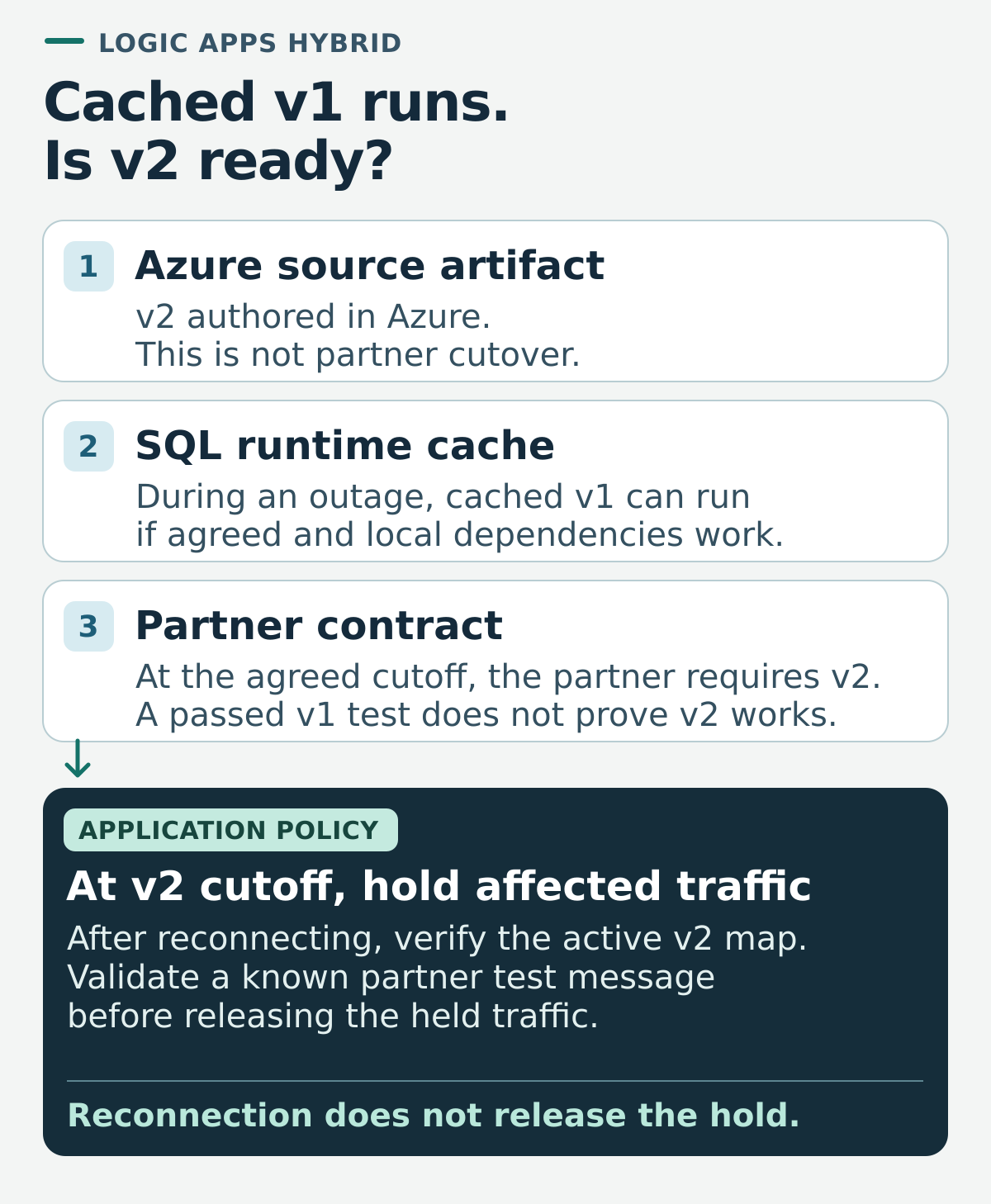
On November 20, Microsoft announced semi-connected Integration Account support for Hybrid Logic Apps. With SQL Server as runtime storage and durable artifact caching enabled, the hybrid runtime can use previously synchronized supported schemas, maps, partners and agreements when it temporarily cannot reach Azure. The Azure Integration Account remains authoritative. First synchronization and later updates require connectivity, and the runtime must still be able to reach its SQL database.
Microsoft separately announced general availability of SQL runtime storage for Hybrid Logic Apps, not for regular Azure-hosted Logic Apps Standard. Neither announcement makes every workflow independent of Azure. Some signing or decryption operations still need live access to a private key in Azure Key Vault. Test those separately from a local XML transform. The hybrid requirements also describe up to 24 hours of local logging retention while disconnected. That is a logging limit, not an availability commitment.
Make the partner cutoff an explicit rule
In this example the partner contract uses a versioned XML namespace and a 10:00 cutoff in an agreed time zone. Suppose the new schema and map are already in Azure, but connectivity dropped before the team verified them on the hybrid runtime. Before 10:00, a version 1 order can still run if version 1 is allowed and all dependencies are available. At 10:00, the partner requires version 2. Hold version 2 orders until the local workflow can prove it selects and runs the right artifacts. Route late version 1 orders under the partner’s exception policy instead of silently transforming them. Leave unrelated, validated flows alone.
Use a locally durable record for held orders, with a business reference, expected contract version, hold reason and owner. Keep payload access restricted. Agree in advance which timestamp governs orders already in flight and how to handle resends. Record the expected artifact names and release identifiers in the deployment record; the arrival timestamp and a successful transform cannot tell you which contract or artifact was used. This is a gate you design in the integration, not a rule the SQL cache enforces.
Reopen the flow with evidence
After reconnecting, verify the required artifacts have synchronized. Then run a known version 2 order through the same map-selection path as live traffic, with downstream delivery disabled or directed to a test sink. Use a fixture that would fail under version 1, such as a new partner-required field, and check the expected output rather than just a green workflow run. Record which workflow and artifact versions passed, who authorized release, and which held orders can now be reprocessed. If a dependency or test is still unverified, keep that route held.
Rehearse the outage twice: first with a warm cache and a still-valid version 1 order, then across the version 2 cutoff without a verified version 2 artifact. The first run should produce the expected output; the second should record a hold and produce no outbound order. On reconnection, the fixture should pass before the held route is reopened. If restart during an outage matters, add a separate restart test rather than treating the warm-cache run as evidence.
My older BizTalk deployment note shows how we separated a full deployment package from a smaller set of versioned changes. Here the change is delivered differently, but the question remains: can the operator prove which version is in use and whether that version is still valid for the next order?
Join the discussion
You must be logged in to post a comment.