It’s Friday. Accounts payable has three payments ready, but one supplier record has a city and no verified country. The city is Cambridge. The payment is C$8,400. Do you stop the run, guess the country, or hold that one payment?
In this fictional example, I would hold the C$8,400 payment and keep the other two moving only if the approval policy allows a partial release. The key design choice is to make the hold a recorded decision in the payables workflow, before the bank file is generated. Editing a bank file after approval breaks the link between what someone reviewed and what treasury actually sent.
Decide what “supplier country” means first
Cambridge could mean Ontario, England or Massachusetts. A lookup might return Canada, the United Kingdom or the United States. Even the right city would only tell you where an address is. For this example, the field means the country where the exact legal entity on the invoice is registered. The remittance address, beneficiary bank country and payment currency are separate facts. A US bank account can belong to a supplier registered elsewhere.
I would ask supplier master data to match the invoice entity to an onboarding record or registry evidence accepted by policy, using the legal name and registration number where available. Keep the original source value, the verified country, a reference to the evidence, the reviewer and the effective version of the supplier record. Store the evidence itself in the restricted system, not in an integration log. Use a country code such as CA to normalize the result; ISO 3166 standardizes the representation, not how you prove which country applies.
Make the Friday decision before building the file
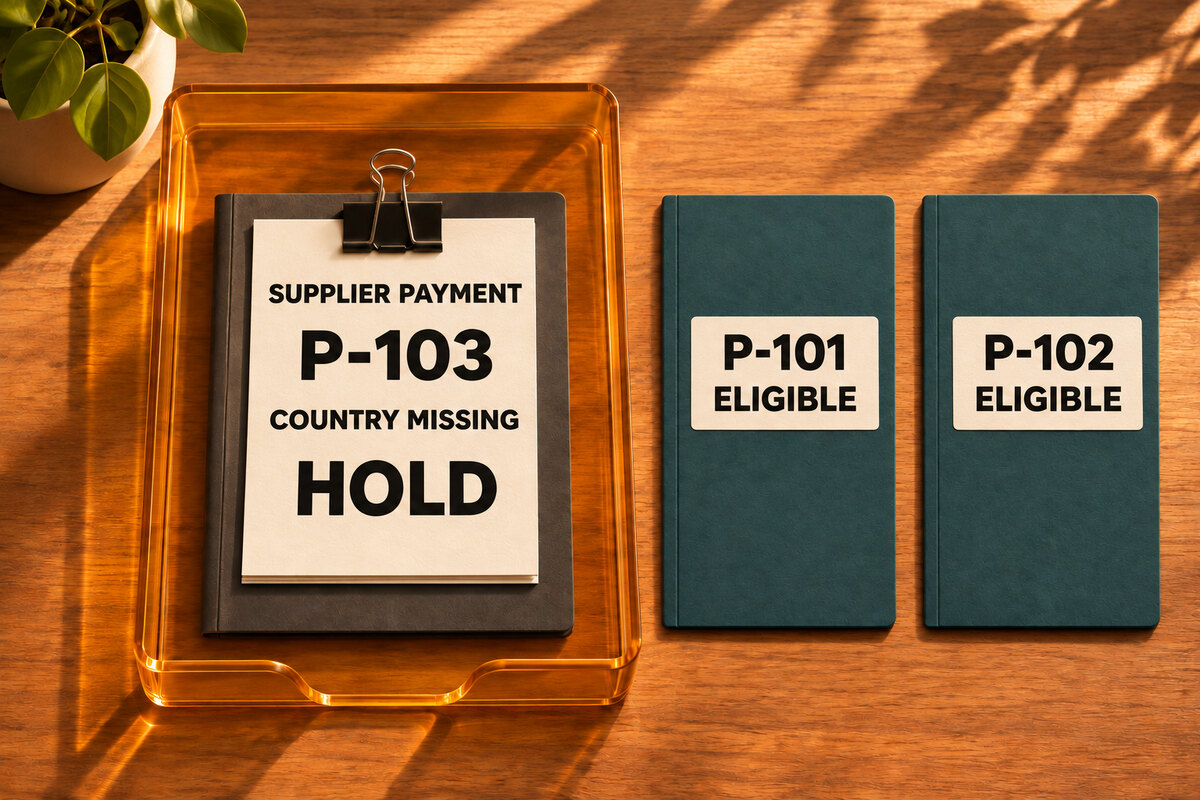
Run B-047 contains three proposed payments totaling C$27,000. P-101 and P-102 total C$18,600 and pass the checks. P-103 is the C$8,400 exception. Record its hold against the original run and payment ID, with the reason, owner and time. Then check whether Friday’s two clean payments can go forward on their own. If policy permits, route that exact C$18,600 set through the applicable approval and generate the bank file from that set. If the policy requires approval of the whole run or the original approval cannot be narrowed, stop and obtain the required approval. Do not silently reuse the original three-payment approval.
Oracle Fusion Cloud provides one example of where to enforce this. When payment approval is enabled for payment process requests, the process stops at proposed payment review, where approvers can remove payments before approving the request. That is an example of the control point, not a claim that every ERP or approval policy allows partial release.
Preserve the trail when the hold clears
Suppose verification later establishes the invoicing entity is registered in Canada. Record the corrected supplier version and link it to the original hold. In this example, the policy requires a fresh payment approval after the correction. That approval is for P-103 on the corrected record, not a reopen of the first two payments. Carry the same internal payment ID into the later run, verify it was not already submitted or paid, and attach the new approval and submission reference to the original exception.
For Friday’s reconciliation, I want to see two payments approved for C$18,600, one held for C$8,400, three proposed for C$27,000. Compare the approved IDs, count and amount to the generated instructions. Track bank outcomes separately: file built, file submitted and payment settled are different states. If transmission times out, establish what the bank received before sending another file. A timeout by itself is not a reason to resend.
The test I’d give an operator is simple: show me why P-103 stayed out on Friday, who approved the two payments that went ahead, and what evidence and approval eventually cleared P-103. If you can answer from the payment records without reconstructing the day from emails or spreadsheets, the exception path is doing its job.
Join the discussion
You must be logged in to post a comment.